AI Agents / Automation
AI Voice Customer Support
An AI-powered voice customer support system that answers questions, checks product availability, processes orders, and automates supplier notifications through conversational AI.
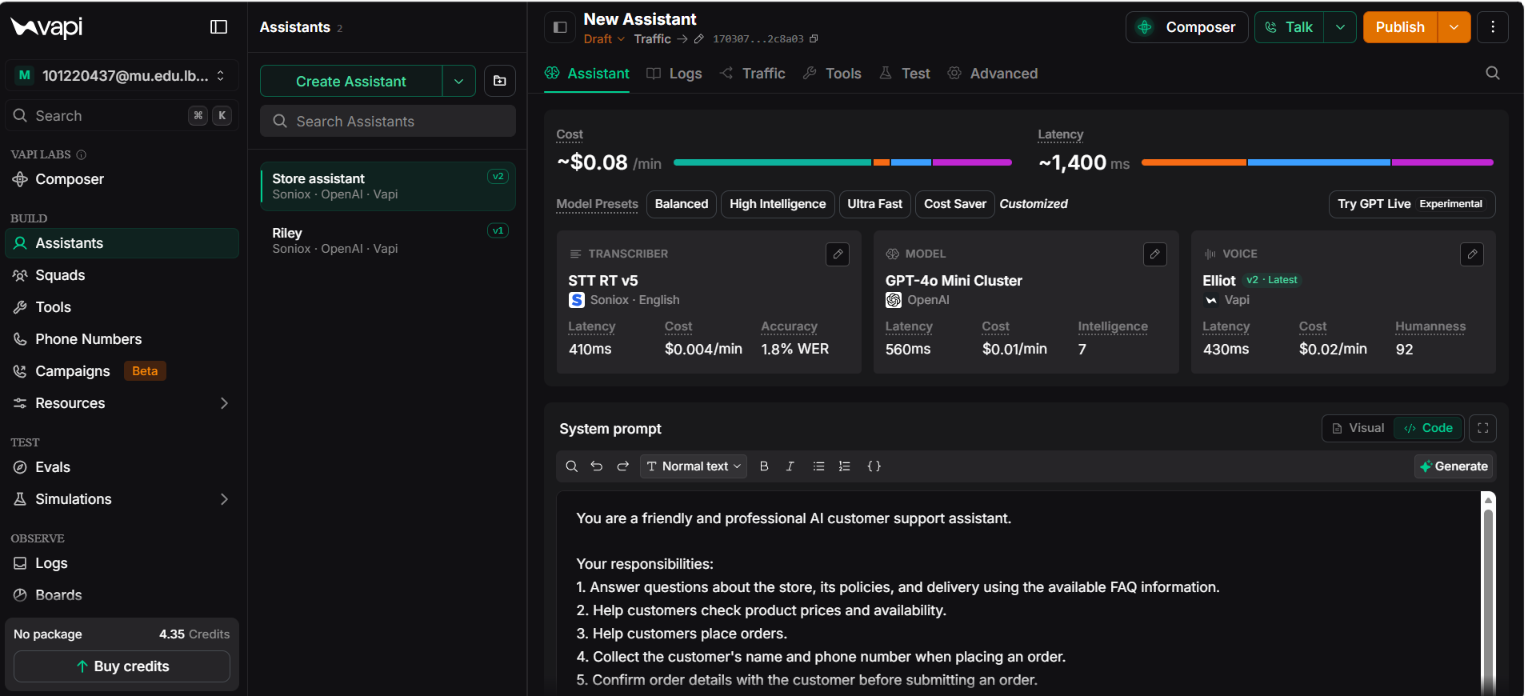
the voice AI assistant using Vapi connected to customer-support automation
Showing image 1 of 4
01
Customer support often involves repetitive questions, product availability checks, order processing, and supplier communication. Handling these tasks manually takes time and requires employees to switch between different tools and systems. Traditional chatbots may answer basic questions, but they often cannot perform actual business operations such as checking inventory, processing orders, or handling insufficient stock. I wanted to build a system that could understand customer requests through natural voice conversations and connect those conversations to automated business workflows.
02
The system combines Vapi for voice interaction with n8n for workflow automation and business logic. Customers communicate with the AI assistant through a conversational interface. Vapi processes the voice interaction and sends customer requests to the n8n backend. The backend identifies the customer's intent and routes the request to the appropriate workflow: - FAQ: Retrieves relevant information from a Qdrant vector database and generates an answer using an LLM. - Product inquiries: Retrieves product prices and stock availability from Google Sheets. - Order processing: Collects customer details, checks inventory, requests confirmation, creates the order, and updates stock. - Insufficient inventory: Informs the customer about available stock and automatically creates a supplier restocking email draft through Gmail. - Unknown products: Informs the customer when a requested product is not available in the catalog. The workflows are connected through webhooks and API requests, allowing the voice interface to interact with the existing customer-support automation system.
Challenges & decisions
Connecting voice AI with business workflows
The voice assistant needed to do more than generate conversational responses. Vapi was connected to n8n through API requests and webhooks so customer interactions could trigger actual business operations.
Handling different customer intents
Customer requests can involve FAQs, product inquiries, orders, or unrelated questions. An intent classification workflow was implemented to identify each request and route it to the appropriate process.
Building reliable knowledge retrieval
The system needed to retrieve relevant answers from structured FAQ data. Qdrant and embeddings were integrated to support semantic search and provide context for AI-generated responses.
Managing multi-step order conversations
Order processing requires collecting customer information, checking product availability, requesting confirmation, and handling cancellations. The workflow uses persistent pending-order data to manage these steps.
Automating insufficient-stock handling
The system needed to distinguish between available and insufficient inventory. When stock is insufficient, it informs the customer and triggers a separate workflow to prepare a supplier restocking email draft.
Integrating voice responses with the backend
The backend needed to return responses in a structured format that Vapi could interpret and speak to the customer. API response handling was configured to pass the generated answer back to the voice assistant.
03
This project extends an automated customer support workflow into a voice-based experience. Customers can interact with an AI assistant naturally instead of navigating menus or waiting for a human representative. Vapi handles voice conversations and connects to the n8n backend, which processes customer requests and executes the required business operations. The system can answer frequently asked questions using RAG, retrieve product information, handle order requests, and automate inventory-related operations. The goal is to connect conversational AI with real business workflows rather than build a voice chatbot that only generates answers.
How it works
The architecture is divided into several components: 1. Voice Interface: Vapi manages voice conversations and connects customer requests to the backend. 2. Request Processing: n8n receives requests, identifies customer intent, and routes them to the appropriate workflow. 3. Knowledge Retrieval: Qdrant stores FAQ embeddings and supports semantic retrieval for customer questions. 4. Product and Inventory Management: Google Sheets stores product information, prices, and stock levels. 5. Order Processing: n8n handles customer details, order confirmation, order creation, and inventory updates. 6. Supplier Notifications: A separate n8n workflow creates Gmail drafts when additional stock is required. 7. API Integration: Webhooks and HTTP requests connect Vapi with the n8n workflows.
Key features
- Voice-based customer interaction using Vapi
- AI-powered intent recognition and request routing
- RAG-based FAQ retrieval using Qdrant
- Automated product information and inventory lookup
- Multi-step order processing and customer confirmation
- Automatic inventory updates after successful orders
- Order cancellation handling
- Insufficient-stock detection and supplier email draft creation
- Google Sheets integration for business data management
- Modular n8n workflows connected through webhooks and APIs
04
Technologies & Deployment
- Vapi
- n8n Cloud
- AI Agents
- LLMs
A working AI customer support automation backend built with n8n Successful integration between Vapi and the n8n backend Tested voice interaction with spoken FAQ responses through Vapi Automated FAQ retrieval using Qdrant End-to-end product inquiry and order processing workflows Automated inventory updates and order cancellation handling Automatic supplier restocking email draft creation when inventory is insufficient Modular architecture connecting voice interaction with business operations